Welcome to the Advancing the Integration of Clean Water Act Programs with Natural Hazard Mitigation Planning & Implementation project website!
This new training program is designed to aid states, territories, local communities, and Tribes in integrating their Clean Water Act programs with their natural hazard mitigation programs. It is a partnership of the National Association of Wetland Managers (NAWM), the Association of State Floodplain Managers (ASFPM), and the U.S. Environmental Protection Agency (EPA), funded by EPA.
Beginning in 2023, NAWM and ASFPM will host one in-person training workshop a year for five years. Each year, the workshop will be delivered to a different regional cohort. The goal of the project is to build cross-governmental relationships and awareness of what is going on in different departments, agencies, and at various levels of government in terms of hazard mitigation and water resource protection planning and program development. Each regional cohort will include representative pairs from 9 communities, 9 states, and 2 Tribes. Although not pictured on the map below, U.S. territories will be included in this project with Regional Cohort C in Green and can recommend communities located within their territorial boundaries. The state and territory pairs will be from the same state or territory in which the local community is located to facilitate relationship building. We anticipate that we will reach participants from 45 states and 10 Tribes.
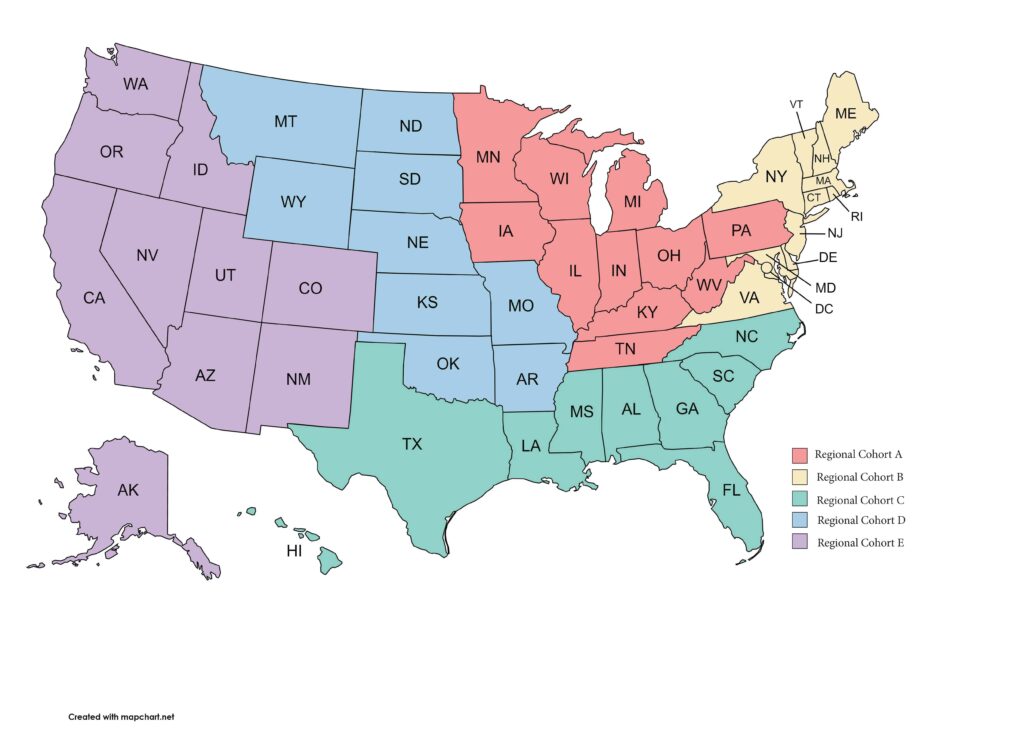
Please note, NAWM and ASFPM may not approach each cohort in the order listed here.
In addition to the five training workshops , there will be quarterly cohort calls and a ten-part webinar series on associated topics. The webinar recordings, materials and tools created for the training workshops, along with other information and resources on best practices, lessons learned and relevant case studies will be posted to on this project website as they become available.
Interested in a workshop? Learn how to sign up.
Background
Historically, natural hazard programs have worked from a reactionary position – to act quickly in response to natural disasters instead of mitigating impacts before disaster strikes. Likewise, water quality and aquatic resource programs have relied on an aging infrastructure system to support water quality needs. Our nation is now much better equipped to predict natural hazards due to advances in technology and modeling, and a much more holistic understanding of the inter-relationships between wetland and natural floodplain functions, watershed dynamics, and the level of resiliency that nature-based solutions can provide for protecting communities from natural hazards. This training program looks to bring these advances to the forefront to advance cross-sector planning and implementation in these areas.