Suggested Citation:

Association of State Floodplain Managers. May 2026. 2025 State and Territory Floodplain Management Assessment. Madison, WI. no.floods.org/FPM2025.
About the Report
The 2025 State and Territory Floodplain Management Assessment [.pdf] is a summary of states’ and territories’ responses to the 2025 State and Territory Floodplain Management assessment undertaken by ASFPM with assistance from the University of Wisconsin Survey Center. Similar assessments in 1989, 1992, 1995, 2003, 2010, and 2017 allowed ASFPM to compile its national tally of the practices by which state and local governments manage floodplains.
This 2025 assessment focused on state-level practices in the floodplain management arena, and was divided into 10 sections according to the 10 guiding principles of effective floodplain management listed on the Introduction page.
Some of the questions from the prior (2017) round of the assessment were modified for clarity, or removed for the sake of reducing the burden on those taking the assessment. Several new questions, mostly on state floodplain management programs’ access and use of FEMA National Flood Insurance Program (NFIP) data and privacy concerns, were added in 2025. The 39 states that completed 75% or more of the assessment in 2017 were provided with those responses as a way to save them time in completing the current round of the assessment.
The assessment was completed between February and March 2025. A link to the questionnaire was sent to the lead floodplain manager in each U.S. state and major territory. 42 states/territories completed at least one question in the assessment, while 14 states/territories did not complete any of the questions in the assessment (see Map 1.1). All responses were included in the analysis. The responding floodplain management coordinators came primarily from state natural resources/conservation agencies, with some from water resources agencies and emergency management agencies (see Table 1.1 below).
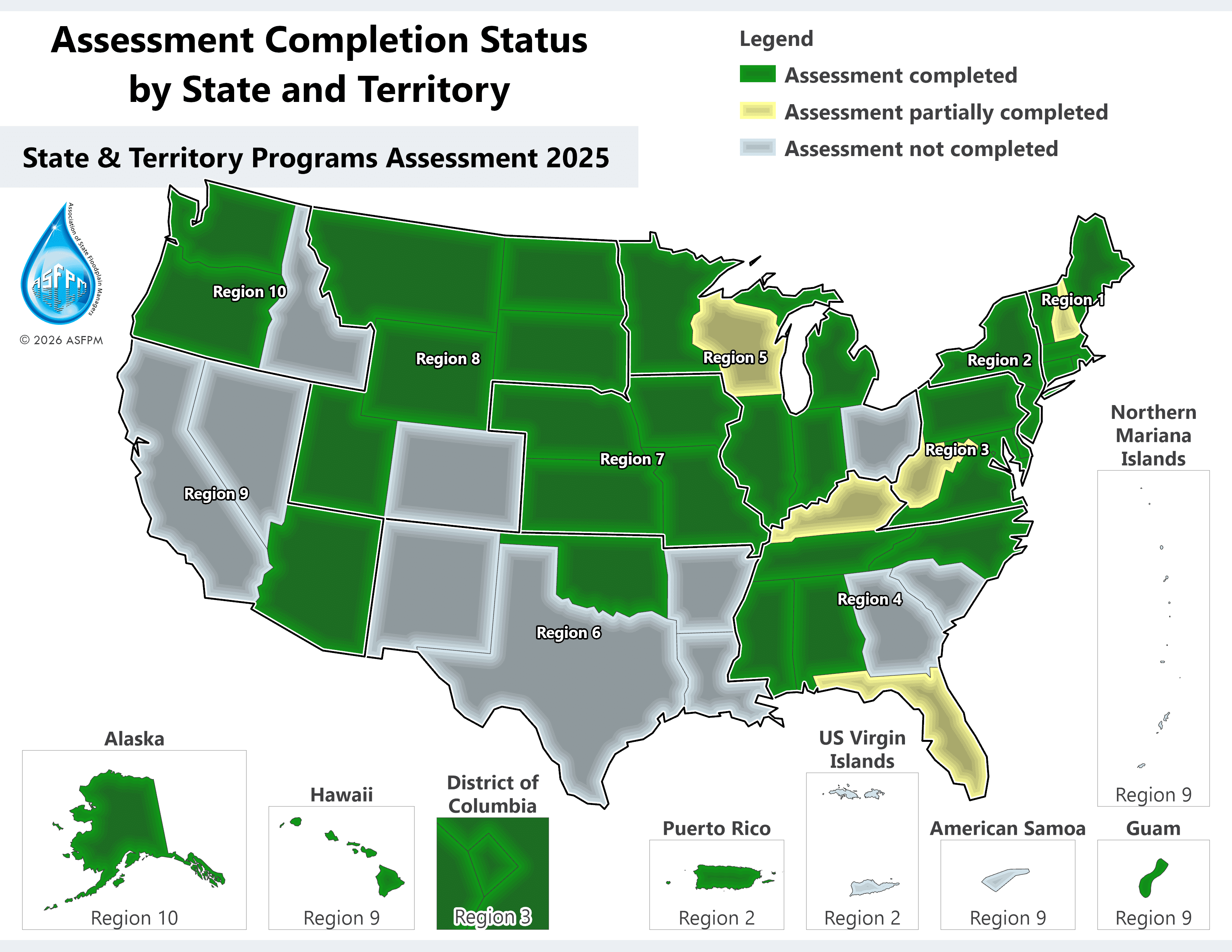
Map 1.1. Geographic distribution of states that responded to the 2025 State and Territory Floodplain Management Assessment. States and territories in green completed all or a majority of the questions, while states and territories in yellow completed a portion of the assessment (their responses are included in the results). States and territories in gray did not answer any of the questions in the assessment.
Table 1.1. Primary Agency Operating the State Floodplain Management Program
Organization of the report
Like the assessment itself, this report is divided into 10 sections according to the 10 guiding principles of effective floodplain management. The section for each principle in the report has three components: a description of the guiding principle, highlights of important/significant findings, and question-by-question summaries of 2025 assessment responses (and comparisons to 2017 results, as appropriate). Throughout this report, we have provided the text from the 2025 assessment questions, which are also available in the Appendix.
Note: This website only contains the guiding principle descriptions and assessment highlights. See the full 2025 State and Territory Floodplain Management Assessment [.pdf] report for question-by-question summaries. Find the 2025 State and Territory FPM Assessment Appendix, Questionnaire, and Full Results in the Additional Materials section below.
Disclaimers
- Many comparisons between 2017 and 2025 results are not included in this report due to differences in how percentages were calculated; the 2017 report generally used a total N value of all respondents to the assessment, while 2025 used an N value of only the number of responses to each individual question. In other words, non-responses were treated as “lazy no’s” in 2017 but not in 2025.
- In 2025, “yes” percentages were artificially high in some instances due to how the questions were formatted this round (“yes/no” rather than ‘check all that apply’) and some respondents skipping checking the “no” box when applicable. In these instances, the summaries talk about the number of respondents rather than the percentage. (This was most prevalent for questions that provided “other” as an option.)
- Perplexity AI was used for the initial summaries of assessment results; however, this output was thoroughly factchecked, corrected, and rewritten as needed for this final report.
- Not all states and territories completed the assessment, and there were a different set of states and territories who completed questions in 2025 versus 2017. Therefore, results for 2025 reflect the characteristics of the respondents who completed the assessment in that year rather than representing the situation in all U.S. states and territories, and comparisons between 2025 and 2017 results do not necessarily imply strong trends as there were different states/territories answering in different assessment rounds.
Acknowledgements
This guide was funded by the Federal Emergency Management Agency (FEMA).
Focus group – the following individuals provided valuable input for the revision and update of the state assessment upon which this report is based:
- Joy Duperault, CFM – Director, Massachusetts Flood Hazard Management Program, NFIP Coordinator & Dep. Hazard Mitigation Officer, Department of Conservation & Recreation
- Ceil Strauss, CFM – Minnesota State Floodplain Manager, Minnesota Department of Natural Resources – Ecological & Water Resources
- Corey Garyotis, PE, CFM – State of Alabama NFIP Coordinator, Alabama Dept. of Economic and Community Affairs, Office of Water Resources
- Rebecca Pfeiffer, CFM – Manager, River Corridor and Floodplain Protection Program / NFIP Coordinator, Vermont Department of Environmental Conservation, Watershed Management Division
Special appreciation is extended to Aaron Carranza, P.E., CFM – Regulatory Division Director, North Dakota Department of Water Resources, for reviewing this publication, and to the University of Wisconsin Survey Center for revising the assessment.
Research, data analysis, project management, data visualization, copy editing, website development, and final formatting and design were completed by the following ASFPM staff:
- Jeff Stone, GISP, CFM – Research Director & Project Manager
- Beth Klusinske – Research Analyst and Technical Editor
- Jason Hochschild – Web and GIS Administrator
Additional materials
2025 State and Territory Floodplain Management Assessment full report [.pdf] containing:
- descriptions of the guiding principles
- highlights of important/significant findings
- question-by-question summaries of 2025 assessment responses (and comparisons to 2017 results, as appropriate)
2025 State and Territory FPM Assessment
2025 FPM Assessment Appendix [.pdf] containing:
- all questions
- all response frequency tables
- all verbatim responses
2025 FPM Assessment Appendix
2025 FPM Assessment Questionnaire [.pdf] containing:
- the web-based assessment instrument as provided to state floodplain managers
2025 FPM Assessment Questionnaire
2025 FPM Assessment Results Table and Encodings [.zip] containing:
- table of responses to all questions [.csv]
- variable codebook of headings used in the table of responses [.csv]
- table encodings document for each question [.docx]