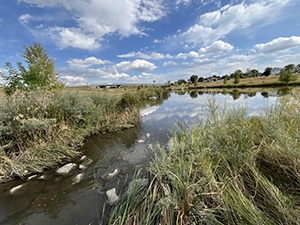
 This second of five Advancing the Integration of Clean Water Act and Natural Hazard Mitigation Planning and Implementation project workshops was held September 16-18, 2025 in Denver, Colorado. The workshop aimed to facilitate collaborative partnerships and build cross-governmental relationships and awareness of what is going on in different departments, agencies, and at various levels of government in terms of hazard mitigation and water resource protection planning and program development. Participants came from Arizona, Colorado, Hawaii, Nevada, New Mexico, Utah, Washington, and the La Posta Band of Mission Indians. The workshop brought participants together with a cadre of leaders in the fields of water and hazards management. Throughout the workshop, discussions were held on integration and partnering, coming to a common language on frequently used water quality and hazard mitigation terms, floodplains, wetlands, and green infrastructure, hazard mitigation, local permitting & regulations, funding mechanisms and how to combine funding sources, and benefit-cost analysis. A mobile tour of the Mile High Flood District's Little Dry Creek project at Westminster Station was included as well. The event was hosted by the National Association of Wetland Managers (NAWM) and the Association of State Floodplain Managers (ASFPM) with the U.S. Environmental Protection Agency (EPA), funded by an EPA cooperative agreement.
Workshop Materials
- Event program (including agenda, handouts, and glossary)
Opening Remarks
Floodplains, Wetlands, and Green Infrastructure
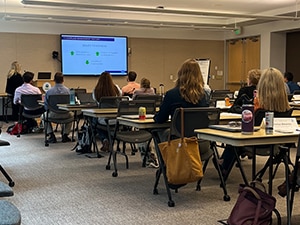 A key component of nature-based natural hazard mitigation is restoring and/or replicating the functions of naturally occurring ecological resources. This session will focus on the interplay of floodplains and wetlands within a watershed, the benefits they provide for both clean water and hazard mitigation, and how green infrastructure can be used to restore watershed functionality. Case studies will be drawn from Colorado, Montana, and New Mexico.
- Karen Menetrey, Director of Ecological Opportunities, Rio Grande Return
- Becky Pierce, Wetland Program Manager, Colorado Department of Transportation
- Traci Sears, CFM, MT National Flood Insurance Program (NFIP) Coordinator, Montana Department of Natural Resources and Conservation
Integrated Water Quality and Hazard Mitigation Planning
Both hazard mitigation and Clean Water Act programs rely on strong cooperation across multiple levels of government to achieve their goals and outcomes. This session will feature presentations from federal agency professionals representing EPA and USACE discussing their integrated watershed planning efforts. Panelists will speak about their roles and experience and outline collaboration opportunities between agencies and among hazard mitigation and Clean Water Act planning.
- Ellie Flaherty, Biologist, U.S. Environmental Protection Agency
- Estella Moore, Life Scientist, U.S. Environmental Protection Agency
- Derek Schriner, Engineer/Nebraska Silver Jackets Coordinator, U.S. Army Corps of Engineers
Coming to a Common Language
Often water quality and hazard mitigation professionals use their own unique terminologies and acronyms that are not readily understood outside of their respective fields. This discussion will focus on defining terminology used in both water quality and natural hazard mitigation practices and identifying the dual benefits of many projects implemented.
- Ian Grosfelt (facilitator)
Wildfires and Water Management
Wildfires can cause a plethora of water quality hazards in addition to their destructive force against communities and ecosystems. They can lead to soil erosion, increased flooding risk, and water pollution from the flow of debris contaminants. This session will cover various integrated watershed strategies and programs at both state and regional levels in from a western context.
- Jocelyn Harimon, Nonpoint Source Program, New Mexico Environment Department
- Jeff Sickles, Technical Expert, Olsson
- Alex Funk, Director of Water Resources, Teddy Roosevelt Conservation Partnership
Planning for Water Scarcity
Water quantity and availability is a persistent issue faced by the semi-arid regions throughout the Western US. This session will delve into resources available through the National Integrated Drought Information System and what a water conservation district in Colorado is doing to plan for and mitigate the risks of water scarcity.
- Sean Cronin, Executive Director, St Vrain and Left Hand Water Conservation District
- Veva Deheza, Executive Director, NOAA National Integrated Drought Information System
Permitting & Regulations Across Water Quality and Mitigation Projects
Understanding the permitting and regulatory requirements for constructing nature-based mitigation and water quality projects is a key element to the successful design and implementation of these strategies. This session will talk through permitting processes and resources available through the U.S. Army Corps of Engineers and will feature a conversation of how a Mile High Flood District navigated permitting.
- Aaron Eilers, Senior Project Manager, U.S. Army Corps of Engineers
- David Skuodas, Director of Design, Construction, and Maintenance, Mile High Flood District
- Mary Powell, Environmental Manager, Mile High Flood District
Mobile Tour of Project Sites Hosted by Mile High Flood District
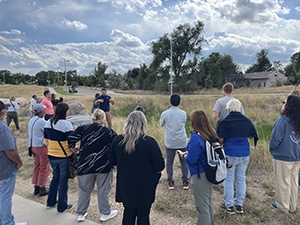 The Little Dry Creek is a large watershed located in an older neighborhood at the inner northwest part of the Denver metro. Mile High Flood District's Little Dry Creek Project was a nature-based infrastructure project that converted grey infrastructure from the 1970s into a diverse plant palette of grasses, shrubs, and trees to stabilize the stream channel and create biodiversity. The project fully incorporated flood and stormwater management, along with environmental and public interests. The design exemplifies working with the inherent character of natural systems, rather than forcing a fixed single objective solution into a setting, allowing the water and system to behave naturally as much as possible. This mobile tour will stop at multiple locations along the watershed including Westminster Station.
- David Skuodas, Director of Design, Construction, and Maintenance, Mile High Flood District
- Mary Powell, Environmental Manager, Mile High Flood District
Funding Mechanisms and How to Combine Funding Sources
There are a number of potential funding opportunities available to assist with hazard mitigation and water quality improvement project planning and construction. This session will focus on the current state of conservation finance and touch on innovative funding sources including various loan, grant, and financing programs currently being used by the Salt River Project, a utility agency in the state of Arizona. Participants will be invited to share their own project funding experiences and challenges.
- Collete Pansini, Water and Forest Planning Analyst, Salt River Project
- Katie Michaels, Director of Partnerships, Conservation Finance Network
Building and Sustaining Relationships
This session will focus on strategies to break down silos and strengthen relationships between water quality and hazard mitigation programs as well as between levels of government. It will include a discussion around approaches to building local coalitions for project targeting and implementation and include examples from Colorado and the western US. The goal is to be able to take lessons and connections from the entire workshop and discuss how to maintain progress towards future collaboration.
- Brian Murphy, River Network
- Katherine Rowden, USACE Silver Jackets
 Download Calendar Event
 Back to Calendar