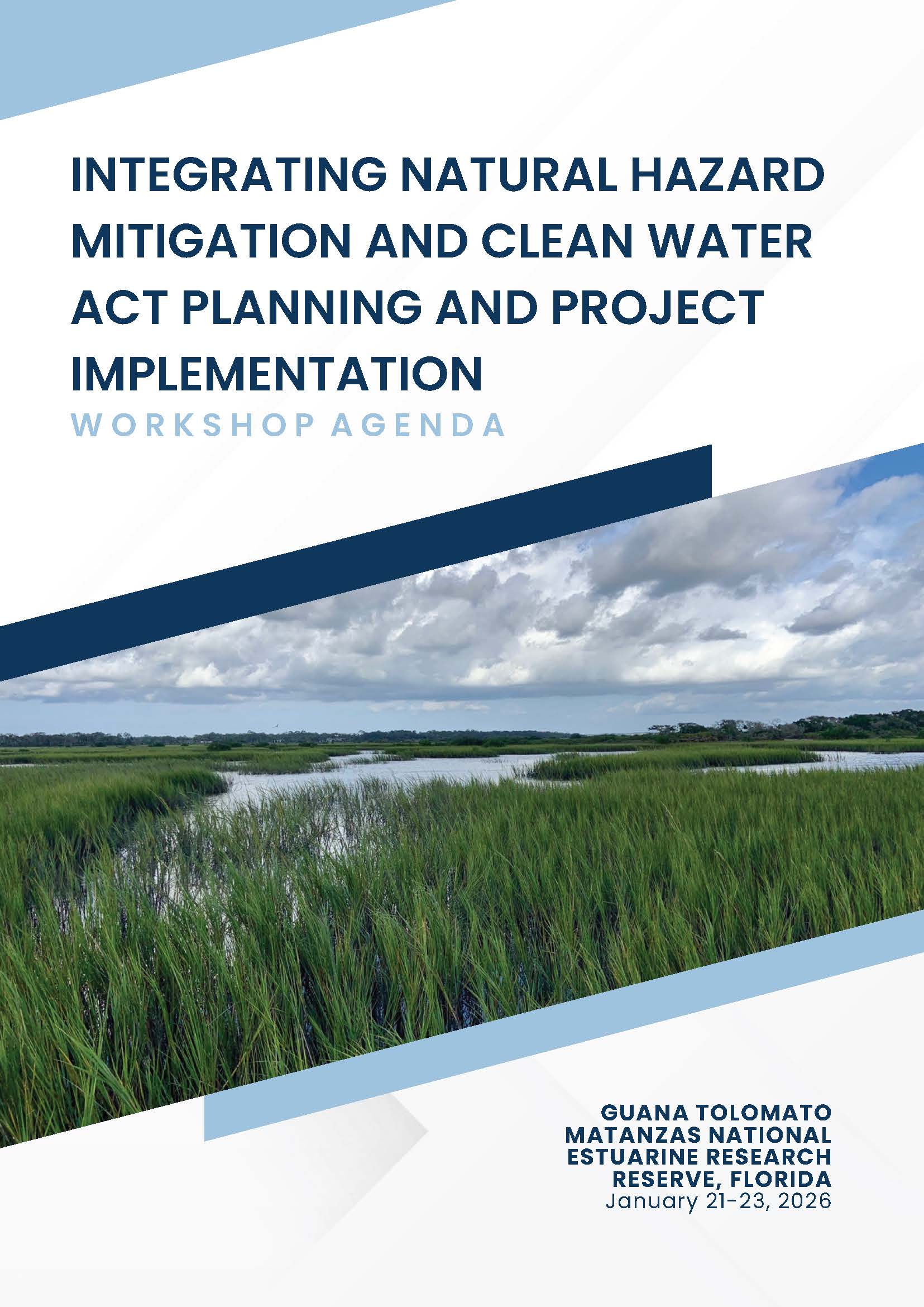
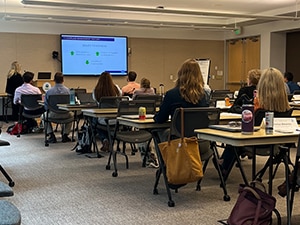
 This third of five Advancing the Integration of Clean Water Act and Natural Hazard Mitigation Planning and Implementation project workshops was held January September 21-23, 2023 in Florida. The workshop aimed to facilitate collaborative partnerships and build cross-governmental relationships and awareness of what is going on in different departments, agencies, and at various levels of government in terms of hazard mitigation and water resource protection planning and program development. Participating states included Alabama, Florida, Georgia, Louisiana, Mississippi, North Carolina, South Carolina, and Texas. The workshop brought participants together with a cadre of leaders in the fields of water and hazards management. Throughout the workshop, discussions were held on integration and partnering, coming to a common language on frequently used water quality and hazard mitigation terms, floodplains, wetlands, and green infrastructure, hazard mitigation, local permitting & regulations, getting to implementation, and building and sustaining relationships. A mobile tour of a Guana Tolomato Matanzas National Estuarine Research Reserve salt marsh restoration project was included as well. The event was hosted by the National Association of Wetland Managers (NAWM) and the Association of State Floodplain Managers (ASFPM) with the U.S. Environmental Protection Agency (EPA), funded by an EPA cooperative agreement.
Workshop Materials
- Event program (including agenda and handouts)
Opening Remarks
Floodplains, Wetlands, and Green Infrastructure
 A key component of nature-based natural hazard mitigation is restoring and/or replicating the functions of naturally occurring ecological resources. This session will move from the downstream coastal wetlands up through to the upstream riverine floodplains to illustrate the interplay of systems within a watershed, the benefits they provide for both clean water and hazard mitigation, and how green infrastructure can be used to restore watershed functionality.
- Lesley Bertolotti, Sustainable Communities Program Manager, The Nature Conservancy
- Ron Brockmeyer, St Johns River Watershed Management District
- Del Schwalls, Schwalls Consulting
Integrated Water Quality and Hazard Mitigation Planning
Both hazard mitigation and Clean Water Act programs rely on strong cooperation across multiple levels of government to achieve their goals and outcomes. This session will feature presentations from federal and state agency professionals discussing the their integrated watershed planning efforts. Panelists will speak about their roles and experience and outline collaboration opportunities between agencies and among hazard mitigation and Clean Water Act planning.
- Ellie Flaherty, Biologist, U.S. Environmental Protection Agency
- Michelle Ellis, Mitigation Division Chief/SHMO, Texas Division of Emergency Management
Coming to a Common Language
Often water quality and hazard mitigation professionals use their own unique terminologies and acronyms that are not readily understood outside of their respective fields. This discussion will focus on defining terminology used in both water quality and natural hazard mitigation practices and identifying the dual benefits of many projects implemented.
- Del Schwalls, Schwalls Consulting (facilitator)
State and Local Huddles
Building off the last session, these state and local huddles will be an opportunity for each state and local pair to talk with one another about their work, and to then talk as a one state group about opportunities for collaboration with one another.
Land Use Planning
Local and regional governments have an array of land use planning tools at their disposal to ensure the resiliency of their communities in the face of new and existing hazards. As development in coastal and floodplain areas continues to increase, integrated land use planning can protect sensitive ecological areas for watershed health as well as people and property. This session will review the role land use plays in watershed management and how where and how we build can affect flooding in a community, before delving the role of planners and how planning is interconnected across departments. It will feature an introduction to the Plan Integration for Resilience Scorecard™, a process to help communities spatially evaluate their networks of plans to reduce hazard vulnerability and protect well-being.
- Joe DeAngelis, Research Manager, Grant Funded Projects, American Planning Association
- Matthew Malecha, Director, Plan Integration for Resilience Scorecard™ Lab, Texas A&M University
Permitting & Regulations Across Water Quality and Mitigation Projects
Understanding the permitting and regulatory requirements for constructing nature-based mitigation and water quality projects is a key element to the successful design and implementation of these strategies. This session provides both a high-level overview of permitting processes and resources available through the U.S. Army Corps of Engineers and a local government perspective of navigating project regulations.
- Tracy Sanders, Senior Project Manager, US Army Corps of Engineers Jacksonville District
- Tim Trautman, Formerly Charlotte-Mecklenburg Stormwater Services
Exercise #1: Barriers to collaboration and implementation
This exercise will engage participants in breakout roundtable discussions on successes and challenges they have faced related to collaboration around integrated planning and implementation of joint projects. Exercise worksheet attached at the end of the agenda.
Hydrologic and Hydraulic Studies
Hydrologic and Hydraulic (H&H) Studies examine the movement of water through a watershed, basin wide impacts, and are important for identifying potential upstream and downstream impacts of a specific project. This session will go over the basics of what an H&H study contains, and delve into how H&H modeling can be used for assessing impacts of stormwater, green infrastructure, and other drainage related projects in mitigating hazards or risks.
- Fouad Jaber, Professor, Biological and Agricultural Engineering, Extension Agricultural Engineering Specialist, Texas A&M
- Bill Brown, Senior Project Manager, ASFPM
Mobile Tour: Guana Tolomato Matanzas National Estuarine Research Reserve Restoration Project
We will view GTM NERR’s salt marsh restoration project to advance best practices towards protecting coastal ecosystems and infrastructure. The project engages multiple stakeholders in the design of an innovative approach focused on using thin-layer placement of dredged sediments to build elevation and increase habitat. We will view the project from a chartered pontoon boat and be joined by project experts to lead discussions. Bring layers appropriate for an afternoon in the temperature of 50-60 degrees on a boat.
- Lia Sansom, Reserve Manager, Guana Tolomato Matanzas NERR
- Nikki Dix, Ph.D., Research Coordinator, Guana Tolomato Matanzas NERR
- Matthew Bernanke, Stewardship Coordinator, Guana Tolomato Matanzas NERR
Getting to Implementation
Funding hazard mitigation and water quality improvement project planning and construction is a challenge for all communities. There are a number of potential funding opportunities available to communities, but how do you sell them to your community? This presentation will discuss potential strategies to establish local funding and then discuss potential supplemental programs or options to supplement and support the community projects. An example of one state's grant programs which are designed to assist communities with projects that could enhance aquatic systems and resiliency will be discussed. Participants will gain a better understanding of the funding sources available to support nature-based practice planning, design, or implementation; the requirements of each funding type; and the process of applying to potentially receive these funds.
- Mackenzie Todd, Coastal Resilience Specialist, North Carolina Division of Coastal Management
- Bill Brown, Senior Project Manager, ASFPM
Exercise #2: Project development scenario
Participants will break into small groups to think through the development of a plan and process for integrating nature-based practices in and around a city to achieve flood risk reduction and water quality benefits. Participants will brainstorm potential project partners, what permit/regulatory needs may there be, what agencies to bring to the table, funding sources, cost/benefit analysis (project justification), what project success looks like, and how it may be tracked. After the analysis is completed, everyone will reconvene to discuss via “report outs” the scenario, the needs/issues identified, and any questions and concerns raised. See the following pages for the exercise worksheet.
Building and sustaining relationships
This session will focus on strategies to sustain and strengthen relationships between water quality and hazard mitigation programs as well as between levels of government. It will include an overview of cross cutting examples of successful projects and partnerships in the Gulf which will lead into a discussion around strategies to establish and make the most out existing relationships to successfully plan and implement projects that will positively impact your community.
- Tracie Sempier, Resilience Engagement Lead, Mississippi-Alabama Sea Grant
State and Local Huddles
Building off the Building and Sustaining Relationships session, state and local pairs will huddle to strategize as a group around how they may bolster their collaboration and actions they might take to ensure their relationships are sustained beyond this program.
 Download Calendar Event
 Back to Calendar