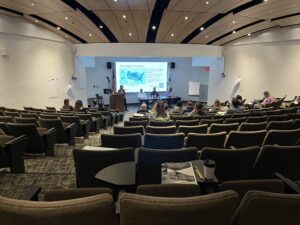
 This first of five Advancing the Integration of Clean Water Act and Natural Hazard Mitigation Planning and Implementation project workshops was held September 12-13, 2023 in Cincinnati, Ohio. The workshop aimed to facilitate collaborative partnerships and build cross-governmental relationships and awareness of what is going on in different departments, agencies, and at various levels of government in terms of hazard mitigation and water resource protection planning and program development. Participating states included Illinois, Indiana, Iowa, Kentucky, Minnesota, and Ohio. The workshop brought participants together with a cadre of leaders in the fields of water and hazards management. Throughout the workshop, discussions were held on integration and partnering, coming to a common language on frequently used water quality and hazard mitigation terms, floodplains, wetlands, and green infrastructure, hazard mitigation, local permitting & regulations, funding mechanisms and how to combine funding sources, and benefit-cost analysis. A mobile tour of the Metropolitan Sewer District of Greater Cincinnati’s Lick Run Project was included as well. The event was hosted by the National Association of Wetland Managers (NAWM) and the Association of State Floodplain Managers (ASFPM) with the U.S. Environmental Protection Agency (EPA), funded by an EPA cooperative agreement.
Workshop Materials
- Event program (including agenda, handouts, and glossary)
Opening Remarks
Integration and Partnering
The management challenges and impacts of natural hazards extend beyond just one agency and beyond the boundaries of different programs. Water program integration and nature-based solutions can aid in resilience to flooding and other water related hazards. This session will examine how to build collaborative relationships to strengthen partnerships across goals and activities through integrated planning and implementation. Examples of long-term cooperative partnerships and best practice examples of integrated planning will be discussed.
- Marla Stelk, Executive Director, National Association of Wetland Managers
- Ellie Flaherty, Biologist, U.S. Environmental Protection Agency
- Shubha Shrivastava, CFM, Mitigation Planner, Planning & Safety Branch, Risk Management Directorate, Resilience, FEMA
Coming to a Common Language
Often water quality and hazard mitigation professionals use their own unique terminologies and acronyms that are not readily understood outside of their respective fields. This discussion will focus on defining terminology used in both water quality and natural hazard mitigation practices and identifying the dual benefits of many projects implemented. Part of the discussion will focus on the benefits of: ecosystem management versus resiliency enhancements; and local community versus watershed scale planning.
- Ian Grosfelt (facilitator)
Floodplains, Wetlands, and Green Infrastructure
A key component of natural hazard mitigation is replicating the functions of naturally occurring ecological resources. This session will focus on the functional benefits that nature-based solutions provide and how to select design criteria, modeling methods, and project locations for projects in order to maximize ecological benefits while providing opportunities for optimizing hazard buffering capacities. Existing resources to help in these efforts will also be discussed.
- Eileen Shader, CFM, Director, Floodplain Restoration, American Rivers
- Ceil Strauss, CFM, State Floodplain (NFIP) Manager, Ecological and Water Resources Division, Minnesota Department of Natural Resources
- Isabelle Horvath, Infrastructure Specialist, Permits Branch, Water Division, Region 5
Hazard Mitigation
Hazard Mitigation is any sustained action taken to reduce or eliminate long-term risk to life and property from hazards. Mitigation comes in many forms, including projects, plans, and regulations. The effectiveness of hazard mitigation can be enhanced when implemented under a long-term comprehensive planning process. This session will discuss how local, state, and federal agencies work together to: improve local resilience to hazards through planning and project implementation; and better integrate planning efforts where synergies and common goals exist.
- Nick Crossley, Director of the Emergency Management & Homeland Security agency, Hamilton County, OH
- Steve Ferryman, CFM, Mitigation Branch Chief, Ohio Emergency Management Agency
- Steven Greene, Mitigation Planning/Public Assistance Mitigation Supervisor, FEMA
- Shubha Shrivastava, CFM, Mitigation Planner, Planning & Safety Branch, Risk Management Directorate, Resilience, FEMA
Mobile Tour: Lick Run Project
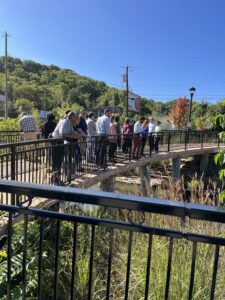 The Metropolitan Sewer District of Greater Cincinnati’s Lick Run Project, completed in 2021, is a "green" wet weather project that focuses on reducing combined sewer overflows (CSOs) in the Cincinnati neighborhood of South Fairmount into Mill Creek, a tributary of the Ohio River. The project uses a combination of green infrastructure, dedicated storm sewers, and real-time controls to eliminate over 800 million gallons annually of CSOs into the creek. This mobile tour will start at Lick Run Greenway’s Forebay Pond before going into the watershed to see its bioswale and stream restoration projects, ending at Headwaters Park.
- Deb Leonard, Communications Manager, Office of the Director, Metropolitan Sewer District of Greater Cincinnati
- Leslie Schehl, P.E., MBA, PMP, Metropolitan Sewer District of Greater Cincinnati
Local Permitting & Regulations Across Water Quality and Mitigation Projects
Understanding the permitting and regulatory requirements for constructing nature-based mitigation and water quality projects is a key element to the successful design and implementation of these strategies. This session will engage the participants to discuss past experiences.
- Suzanne Chubb, Regulatory Program Manager, Great Lakes and Ohio River Division, U.S. Army Corps of Engineers
- Brandon R. Brummett, P.E., PMP, Outreach Coordinator, USACE Louisville District
Funding Mechanisms and How to Combine Funding Sources
There are a number of potential funding opportunities available to assist with hazard mitigation and water quality improvement project planning and construction. This session will focus on various state and federal loan and grant programs which are designed to assist communities with these projects that could enhance aquatic systems and resiliency. Participants will gain a better understanding of the funding sources available to support nature-based practice planning, design, or implementation; the requirements of each funding type; and the process of applying to potentially receive these funds.
- Josh Human, BRIC Partnership Lead, FEMA
- Franny Josephs, CWSRF Financial Analyst, U.S. EPA
- Sanjiv K. Sinha, P.E., Ph.D., CEO, Corvias Infrastructure Solutions, LLC (CIS)
Benefit-Cost Analysis
Protecting communities from flooding through a variety of mitigation techniques is essential to creating a more resilient future. One way to assess the feasibility of a given mitigation project is the benefit-cost analysis (BCA). BCA is a method that determines the future risk reduction benefits of a hazard mitigation project and compares those benefits to its costs. Funding for flood mitigation often relies on the project having a benefit cost ratio (BCR) that exceeds 1. Given the traditional BCA methodology, it can be hard for underserved communities and communities looking to undertake green infrastructure projects to exceed that threshold. This session will explore alternative cost-effectiveness methodologies.
- Jenna Rao, PE, PG, CFM, Engineer, Flood Modeling, Water Science and Conservation, Texas Water Development Board
- Travis Grout, Regional Economist, NOAA Office for Coastal Management
 Download Calendar Event
 Back to Calendar