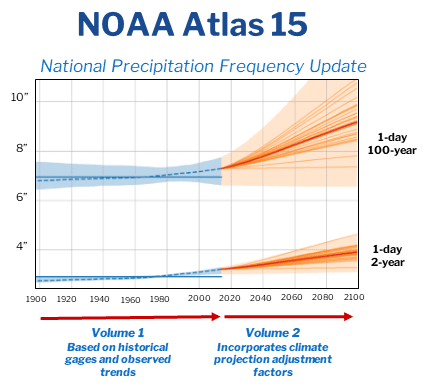
 Flood maps are commonly developed based on historic flood flows. Yet they are used for siting new development that will be in place for 100 years. Flood flows during the life of development is likely to increase due to development in the watershed and increased rainfall intensity due to climate change. This webinar will focus on future conditions mapping.
Atlas 14 is the official peer-reviewed record of precipitation frequency estimates for the United States and affiliated territories which is produced by the National Weather Service (NWS) Office of Water Prediction, part of the National Oceanic and Atmospheric Administration (NOAA). NOAA recently completed a methodology (Atlas 15) to address non-stationarity (the fact that rainfall intensities are not stationary but are changing over time).
Increasing development in watersheds causes flood flows to increase over time. Mile High Flood District uses full build out conditions to calculate flood flows for mapping flood hazard areas in the Denver, Colorado drainage area. In 1999, MHFD received approval from FEMA to use these flood hazard maps to designate the FEMA Special Flood Hazard Area. Thus the SFHAs mapped in the MHFD represent future full build out conditions.
Join us for a discussion of future conditions flood mapping. We will review the non-stationarity methodology recently developed by NOAA and a case study wherein the Mile High Flood District in the Denver, CO area has developed full build out conditions flood mapping to designate the FEMA Special Flood Hazard Area.
Presenters:
- Alan Lulloff, P.E., CFM - ASFPM Flood Science Center
- Meg Galloway, P.E., - ASFPM Senior Policy Advisor
- Sandra Pavlovic, P.E., M.B.A., M.S. - NOAA
- Brooke Seymour, P.E., CFM, - MHFD Planning and Floodplain Management Director
Agenda:
- Webinar Logistics - Kevin Currie, ASFPM Training Coordinator
- Introduction - Alan Lulloff
- ASFPM support of Atlas 14 - Meg Galloway
- Atlas 14/15 Non-stationarity Methodology - Sandra Pavlovic
- MHFD Future Conditions Mapping - Brooke Seymour
- Questions/Discussion
Slides: Future Conditions Flood Mapping
Recording: Future Conditions Flood Mapping
Q & A: Future Conditions Flood Mapping
Note: Viewing the recording of this webinar is not eligible for CECs.
 Download Calendar Event
 Back to Calendar